Foot Care Products Market Set to Reach USD 14.34 Billion by 2035 as Foot Health Awareness Rises
Rising foot health awareness, aging populations, innovative formulations and digital retail are reshaping the global

Press Release Disclaimer: This is a press release distributed through the XPR Media network. It has not been independently verified by our newsroom.
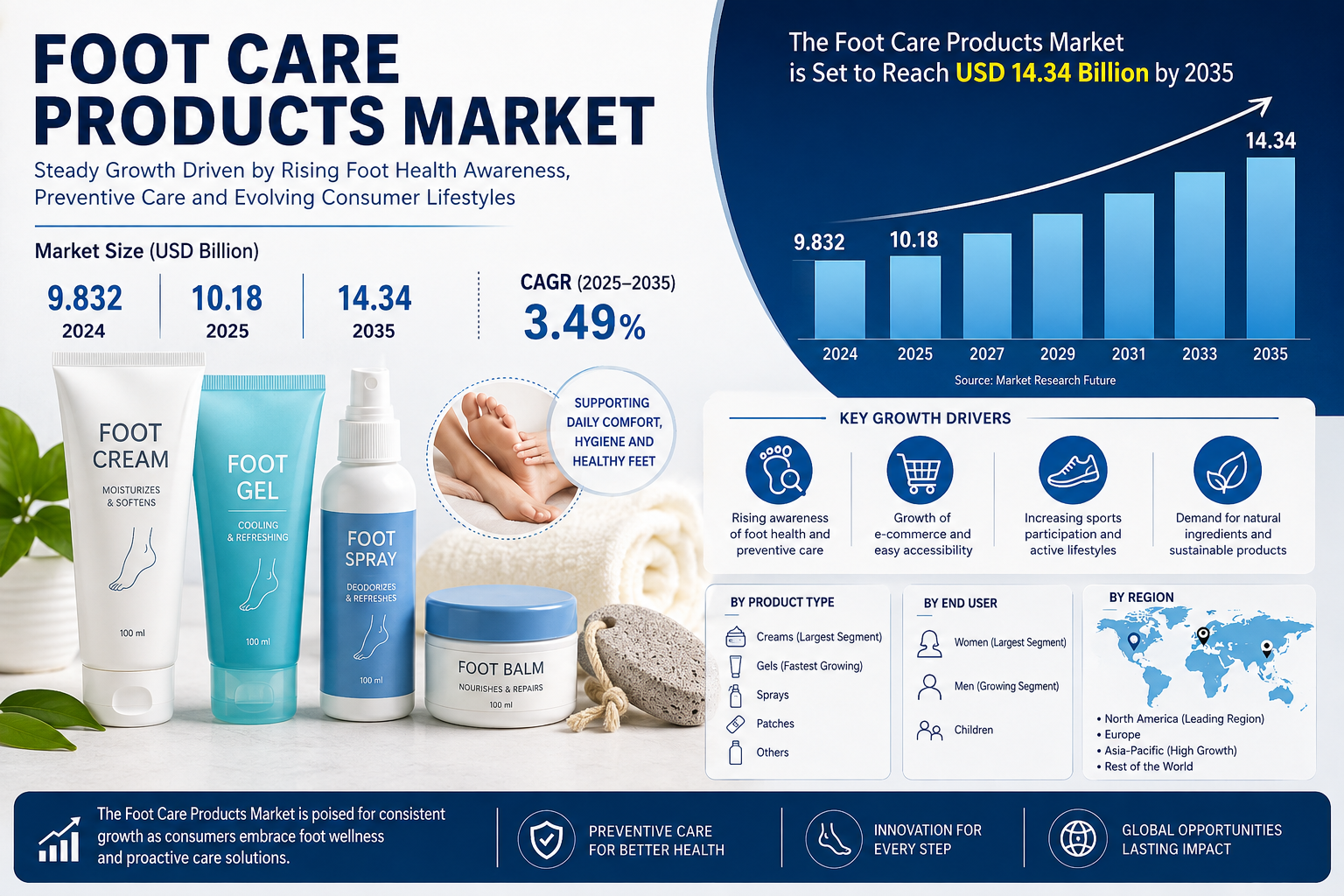

Rising foot health awareness, aging populations, innovative formulations and digital retail are reshaping the global foot care industry.
NEW YORK, NY, UNITED STATES, August 31, 2026 /EINPresswire.com/ — The global Foot Care Products Market is entering a period of steady expansion as consumers increasingly prioritize foot health, personal hygiene, comfort and preventive wellness. According to an analysis by Market Research Future (MRFR), the Foot Care Products Market was valued at approximately USD 9.832 billion in 2024 and is projected to increase from USD 10.18 billion in 2025 to USD 14.34 billion by 2035, representing a compound annual growth rate (CAGR) of 3.49% during the forecast period from 2025 to 2035.
The market is being shaped by rising consumer awareness of foot health, increased participation in sports and fitness activities, an aging global population, expanding e-commerce infrastructure and continued innovation in foot care formulations. Consumers are increasingly moving beyond reactive treatment and adopting regular foot care routines designed to maintain hydration, hygiene, comfort and overall foot wellness.
The evolving retail landscape is also creating new opportunities for manufacturers and brands. Online channels are giving consumers access to a wider selection of foot creams, gels, sprays, ointments, patches and related solutions, while pharmacies, supermarkets and specialty stores continue to provide important touchpoints for consumers seeking trusted personal-care and health-related products.
Foot Care Products Market Overview
The Foot Care Products Market encompasses a broad range of products designed to address common foot-care requirements, including dry skin, cracked heels, athlete’s foot, fungal infections and heel discomfort. Product categories covered by the market include creams, gels, sprays, ointments and patches, while end users include men, women and children.
According to Market Research Future, the market is projected to grow from USD 10.18 billion in 2025 to USD 14.34 billion by 2035. The forecast reflects a gradual but sustained expansion in consumer demand as foot care becomes increasingly integrated into personal grooming, wellness and preventive health routines.
The market’s development is also being influenced by changing consumer expectations. Today’s buyers increasingly seek products that combine efficacy, convenience and sensory appeal. Fast-absorbing gels, moisturizing creams, targeted patches and easy-to-use sprays are helping brands respond to consumers who want specialized solutions without complicated routines.
At the same time, sustainability is becoming an increasingly relevant consideration in product development. Consumers are showing greater interest in natural or responsibly sourced ingredients, environmentally conscious packaging and formulations aligned with broader wellness preferences.
Get Full PDF Sample Copy of Report: (Including Full TOC, List of Tables & Figures, Chart) @ https://www.marketresearchfuture.com/sample_request/33303
Rising Awareness of Foot Health Supports Market Growth
One of the primary factors supporting the Foot Care Products Market is increasing awareness of the importance of foot health.
Feet are exposed to daily pressure from walking, standing, exercise and footwear. As consumers become more knowledgeable about common foot concerns, demand is expanding for products that support hydration, hygiene, protection and comfort.
Preventive care is emerging as an especially important market trend. Rather than waiting until discomfort becomes severe, consumers are increasingly incorporating moisturizing creams, protective products and specialized treatments into regular personal-care routines.
This transition from reactive treatment to preventive maintenance provides manufacturers with opportunities to develop products for different stages of the consumer journey, from everyday hydration and odor management to targeted solutions for specific foot concerns.
The increasing availability of educational content through websites, social media, healthcare platforms and e-commerce marketplaces is also helping consumers learn about foot-care routines and available product categories.
Sports and Fitness Activities Create Additional Demand
The expansion of sports and fitness participation is another factor contributing to demand for foot care products.
Athletes and fitness enthusiasts place considerable demands on their feet through running, walking, gym workouts, team sports and other physical activities. Increased activity can create demand for products designed to support comfort, protect the skin and address common issues associated with repetitive movement, perspiration and footwear.
This trend creates opportunities for brands to develop specialized offerings aimed at active consumers. Products can be positioned around convenience, recovery, hydration, protection and everyday foot comfort, enabling manufacturers to differentiate their portfolios within an increasingly competitive market.
Sports-oriented consumers are also typically more receptive to performance-focused product innovation. This may encourage manufacturers to explore new formulations, packaging formats and complementary products designed around active lifestyles.
Aging Population Strengthens Demand for Specialized Foot Care
Demographic changes are expected to remain an important long-term influence on the Foot Care Products Market.
As the global population ages, demand for products addressing everyday foot discomfort, dryness, heel problems and other age-associated concerns can increase. Older consumers may also place greater emphasis on preventive care and products that support routine personal hygiene and comfort.
The aging population therefore represents an important opportunity for manufacturers to create targeted product portfolios. Clear labeling, easy-to-use packaging and accessible product information can help brands meet the needs of older consumers.
The broader healthcare and wellness ecosystem also creates opportunities for foot care brands to engage with consumers through pharmacies, healthcare professionals, specialty retailers and educational platforms.
E-Commerce Transforms Foot Care Product Distribution
Digital transformation is reshaping how consumers discover, compare and purchase foot care products.
Online retail provides consumers with access to extensive product ranges, detailed descriptions, customer reviews and educational content. The convenience of home delivery is particularly relevant for personal-care categories, where consumers may prefer discreet and convenient purchasing options.
According to MRFR, online distribution has emerged as the largest distribution channel in the Foot Care Products Market, while pharmacies represent an important and growing channel.
E-commerce is also allowing smaller and specialized brands to reach consumers without relying exclusively on traditional physical retail networks. Digital advertising, social media engagement and influencer-driven marketing can further increase product visibility.
For manufacturers, online channels provide opportunities to analyze consumer preferences, optimize product positioning and introduce targeted offerings to specific demographic groups.
Product Innovation Drives Competitive Differentiation
Product innovation remains central to the evolution of the Foot Care Products Market.
Creams currently represent the largest product category, supported by widespread consumer familiarity and demand for moisturizing and skin-repair applications. Gels are identified by MRFR as the fastest-growing product category, reflecting consumer interest in lightweight, fast-absorbing and convenient formulations.
Sprays, ointments and patches also serve distinct consumer needs. Sprays can appeal to consumers seeking quick and convenient application, while patches can offer targeted solutions. Ointments continue to have relevance in specialized foot-care applications.
Future product innovation is expected to increasingly focus on multifunctionality, ease of application, targeted formulations and sustainability. Brands capable of combining consumer convenience with clear product benefits may be better positioned to capture emerging demand.
Sustainability Becomes an Increasingly Important Market Theme
Environmental considerations are becoming more relevant across the personal-care industry, and foot care is no exception.
Consumers are increasingly examining ingredients, packaging materials and production practices when making purchasing decisions. This creates opportunities for manufacturers to incorporate recyclable packaging, responsibly sourced ingredients and environmentally conscious product-development approaches.
Sustainability can also become a source of brand differentiation. Companies that communicate environmental initiatives transparently while maintaining product quality and performance may strengthen consumer trust.
However, sustainability must increasingly be balanced with affordability, effectiveness and convenience. Successful products will need to meet multiple consumer expectations rather than focusing on environmental credentials alone.
Market Segmentation
According to Market Research Future, the Foot Care Products Market can be analyzed across several major segments.
By Product Type:
•Creams
•Gels
•Sprays
•Ointments
•Patches
By End User:
•Men
•Women
•Children
By Distribution Channel:
•Online
•Offline
•Pharmacies
•Supermarkets
•Specialty Stores
By Condition:
•Dry Skin
•Athlete’s Foot
•Fungal Infections
•Cracked Heels
•Heel Pain
This segmentation highlights the diversity of consumer requirements within the market. Products designed for everyday moisturizing serve a different consumer need from targeted solutions addressing specific foot concerns, while distribution preferences vary according to geography, demographics and purchasing behavior.
Women Represent a Major Consumer Segment
Women represent the largest end-user segment identified in the MRFR analysis. The demand reflects the broad range of personal-care and comfort requirements associated with women’s footwear choices and grooming routines.
Foot creams, moisturizing products, foot peels, specialized treatments and comfort-oriented solutions can all contribute to demand within this segment.
At the same time, the men’s category is becoming increasingly important as awareness of foot health and personal grooming expands. Active men, athletes and consumers seeking specialized wellness products represent opportunities for brands to broaden their portfolios and marketing strategies.
The children’s segment provides another avenue for product development, particularly around hygiene, comfort and age-appropriate formulations.
Regional Market Outlook
The global Foot Care Products Market encompasses North America, Europe, Asia-Pacific, South America, and the Middle East and Africa.
North America remains a leading market, supported by strong consumer awareness, established personal-care brands, developed retail infrastructure and demand for preventive foot health solutions. The United States represents a significant contributor to regional demand.
Europe continues to offer opportunities driven by consumer interest in foot hygiene, wellness and specialized products. Sustainability and natural-product preferences are also increasingly relevant to purchasing decisions across several European markets.
Asia-Pacific represents an important growth opportunity as rising disposable incomes, urbanization, changing lifestyles and growing awareness of personal grooming contribute to increasing demand. Markets such as China, India and Japan provide opportunities for both multinational and regional brands.
South America is expected to benefit from increasing consumer access to personal-care products and the expansion of modern retail and digital commerce.
The Middle East and Africa offer longer-term growth opportunities as consumer awareness, retail infrastructure and disposable incomes develop across key markets.
The regional outlook demonstrates that manufacturers can pursue different growth strategies depending on local consumer preferences, retail structures and levels of foot-health awareness.
Competitive Landscape
The Foot Care Products Market includes established consumer health, personal-care, footwear and specialized foot-care companies. Key companies identified by Market Research Future include Bayer AG, Procter & Gamble Co., Reckitt Benckiser Group plc, Scholl, Dr. Scholl’s, PediFix Inc., Sally Hansen, New Balance and Asics Corporation.
Competition within the market is increasingly extending beyond traditional product availability. Companies are focusing on formulation innovation, product specialization, digital marketing, distribution expansion, brand positioning and sustainability.
Large multinational companies benefit from established distribution networks and strong brand recognition, while specialized and emerging brands can compete through niche positioning, targeted formulations and direct-to-consumer strategies.
The expansion of online retail is also lowering barriers for consumers to discover specialized products, creating additional competitive opportunities for smaller brands.
Opportunities for Manufacturers and Investors
The projected expansion of the Foot Care Products Market creates opportunities across product development, retail, digital commerce and consumer education.
Natural and organic formulations represent one potential area of opportunity as consumers increasingly seek products that align with wellness and sustainability preferences. E-commerce expansion provides another avenue for growth by allowing brands to reach consumers directly and build digital relationships.
Sports and fitness represent an additional opportunity. Manufacturers can develop specialized solutions for active consumers and position foot care as an essential part of broader fitness and recovery routines.
The aging population creates opportunities for specialized products that emphasize comfort, ease of use and routine foot maintenance.
Technology may also play an increasing role. Digital platforms, personalized recommendations and connected wellness solutions could help brands create more engaging consumer experiences as foot care becomes increasingly integrated with broader health and wellness ecosystems.
Future Outlook
The Foot Care Products Market is expected to maintain steady growth through 2035. MRFR projects the market to reach USD 14.34 billion by 2035, up from USD 10.18 billion in 2025, at a 3.49% CAGR during the 2025–2035 forecast period.
The market’s future will be shaped by the intersection of preventive health, personal grooming, convenience, sustainability and digital commerce.
Consumers are becoming more proactive about maintaining foot health, while manufacturers are responding with increasingly specialized products and innovative delivery formats. E-commerce is expanding product accessibility, and pharmacies and specialty retailers continue to provide trusted channels for consumers seeking targeted solutions.
As competition intensifies, successful companies are likely to differentiate themselves through product efficacy, consumer education, formulation innovation, sustainability, accessibility and strong digital engagement.
With increasing awareness of foot health and continued evolution in consumer lifestyles, the Foot Care Products Market is positioned for sustained development over the next decade.
Discover Related Research Reports By Market Research Future:
Tactical Footwear Market
https://www.marketresearchfuture.com/reports/tactical-footwear-market-24257
Foot Patch Market
https://www.marketresearchfuture.com/reports/foot-patch-market-33313
Women Leather Luxury Footwear Market
https://www.marketresearchfuture.com/reports/women-leather-luxury-footwear-market-34536
Market Research Future
Market Research Future
+ +1 855-661-4441
email us here
Legal Disclaimer:
EIN Presswire provides this news content “as is” without warranty of any kind. We do not accept any responsibility or liability
for the accuracy, content, images, videos, licenses, completeness, legality, or reliability of the information contained in this
article. If you have any complaints or copyright issues related to this article, kindly contact the author above.

Media gallery