Hernia Repair Market to reach USD 7.17 Billion by 2035 at 4.6% CAGR
Hernia Repair Market to Surge from USD 4.78 Billion in 2026 to USD 7.17 Billion by 2035—Powered by Robotic-Assisted

Press Release Disclaimer: This is a press release distributed through the XPR Media network. It has not been independently verified by our newsroom.
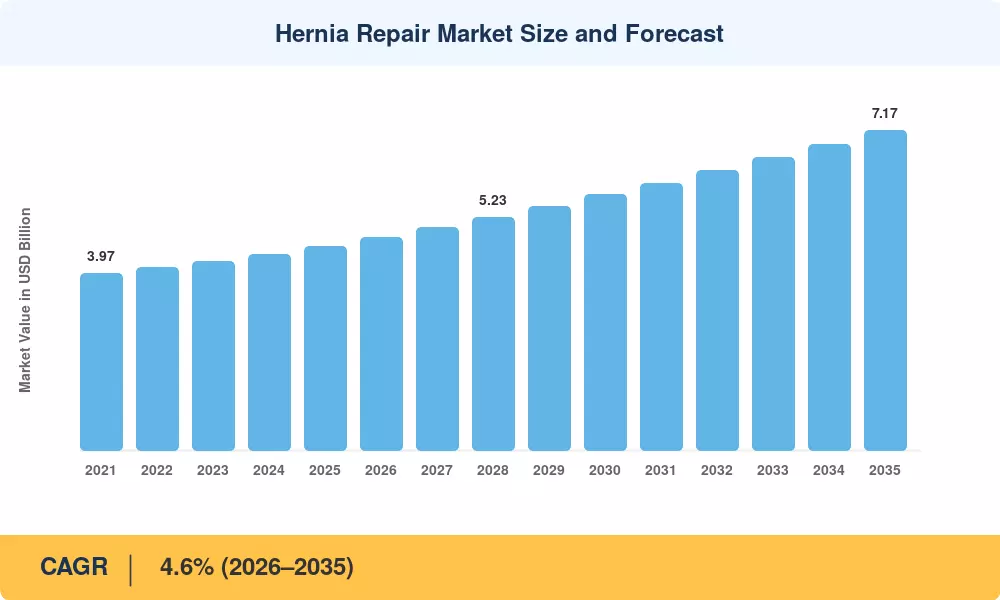

Hernia Repair Market to Surge from USD 4.78 Billion in 2026 to USD 7.17 Billion by 2035—Powered by Robotic-Assisted Adoption, Outpatient Reimbursement Expansion
NY, CA, UNITED STATES, August 17, 2026 /EINPresswire.com/ — As per Market Research Future, the global Hernia Repair Market size is projected to reach USD 7.17 Billion by 2035 from USD 4.78 Billion in 2026, at a CAGR of 4.6% during the forecast period 2026–2035. The market base was estimated at USD 4.57 Billion in 2025.
The 4.6% CAGR—anchored by a convergence of demographic, technological, and policy-driven factors—is propelled by three primary forces: the rising global prevalence of obesity and aging populations, which expand the addressable patient base; the accelerating shift from open to robotic-assisted and minimally invasive procedures, which increases per-procedure device revenue; and the expansion of outpatient and public insurance coverage that is lowering access barriers and driving procedural volumes in both developed and emerging economies.
National governments and multilateral health organizations are amplifying this momentum. The World Obesity Federation projects that 1.5 billion adults will have a BMI above 30 by 2030, directly increasing hernia incidence. In the United States, the CMS expanded ambulatory surgical center (ASC)-eligible codes for complex ventral hernia repair in its 2024 Outpatient Prospective Payment System rule, opening an estimated 180,000 additional procedures annually to the outpatient setting. Similarly, India’s Ayushman Bharat Pradhan Mantri Jan Arogya Yojana added elective hernia repair to its coverage list in 2023, extending cashless surgical access to over 500 million beneficiaries. With similar coverage expansions in Brazil’s SUS system and China’s urban employee insurance programs, these initiatives are creating the procurement infrastructure and clinical demand on which the Hernia Repair Market depends.
Request A Free Sample:
https://www.marketresearchfuture.com/sample_request/2287
Key Market Trends & Growth Drivers
Robotic-Assisted Surgery Adoption and Technological Shift
A significant technology shift is transforming hernia repair, with minimally invasive and robotic-assisted procedures gradually replacing traditional open techniques that have dominated hospitals for decades. Hospital systems added over 1,800 new robotic surgical consoles worldwide in 2024, with hernia repair representing roughly 12% of total robotic general surgery case volume. Robotic platforms reduce conversion-to-open rates by an estimated 35% compared with conventional laparoscopy, allowing surgeons to tackle complex ventral and incisional cases with greater precision. For the Hernia Repair Market, robotic adoption drives a shift toward premium mesh products specifically designed for robotic trocar delivery, increasing average selling prices per procedure. The entry of three new robotic surgery platforms between 2025 and 2028 is projected to reduce procedure costs by 15–20% between 2026 and 2030, further expanding the addressable patient pool for the Hernia Repair Market.
Outpatient and Public Insurance Reimbursement Expansion
The expansion of outpatient reimbursement is a powerful growth catalyst. CMS finalized expanded ASC-eligible procedure codes for complex ventral hernia repair in its 2024 Outpatient Prospective Payment System rule, opening an estimated 180,000 additional procedures per year to the ambulatory setting. The cost differential between hospital inpatient and ASC settings ranges from 40% to 60%, incentivizing payers and patients alike to shift volume. This policy tailwind strengthens the Hernia Repair Market by lowering access barriers and boosting total addressable procedure counts. Concurrently, emerging-market insurance expansion, such as India’s Ayushman Bharat and similar coverage growth in Brazil’s SUS system and China’s urban employee insurance programs, is projected to add a combined 600,000 incremental hernia procedures annually by 2030, directly expanding the addressable market in these regions.
Innovation in Mesh Technology: Biologic and Biosynthetic Hybrids
Older heavyweight polypropylene products are being replaced with lightweight composite mesh configurations designed for trocar distribution and biologic scaffolds that decrease chronic pain concerns. While synthetic mesh products represented approximately 90.5% of market revenue in 2025, the landscape is evolving. Biologic mesh alternatives, used in contaminated-field procedures, are projected to grow at a 6.9% CAGR. A rapidly emerging category is biosynthetic hybrid scaffolds that combine a permanent synthetic core with a resorbable biologic layer. These next-generation platforms aim to deliver the tensile strength of polypropylene with the tissue integration benefits of biologic materials, targeting the estimated 25% of ventral repair cases classified as contaminated or potentially contaminated fields. The Hernia Repair Market stands to gain as hybrid products command premium pricing over conventional synthetic mesh.
Ask for Customization:
https://www.marketresearchfuture.com/ask_for_customize/2287
Market Segment Insights
BY HERNIA TYPE
Inguinal Hernia: Dominant segment with 59.2% revenue share in 2025, reflecting the high global incidence of groin hernias across adult male populations. The segment benefits from standardized repair techniques and broad payer coverage across most geographies.
Incisional/Ventral Hernia: Fastest-growing segment at a 7.1% CAGR (2026–2035), driven by rising bariatric surgery caseloads and an increase in revision surgeries. Obesity-related abdominal surgeries and the corresponding rise in post-surgical herniation rates are key demand drivers.
Other Hernia Types (femoral, umbilical, hiatal): Represent incremental demand channels, with pediatric and specialty repair contributing to market volume.
BY SURGICAL TECHNIQUE
Open Surgery: Largest segment, comprising 62.1% of all hernia surgeries in 2025, remaining the global standard of care for straightforward primary inguinal repairs in community settings.
Laparoscopic Surgery: Established minimally invasive alternative, contributing significantly to procedure volumes with established clinical evidence.
Robotic-Assisted Surgery: Fastest-growing technique at a 7.5% CAGR, propelled by platform expansion, surgeon training programs, and its ability to handle complex cases with premium mesh products. The robotic segment’s higher per-procedure device revenue makes it a disproportionately important growth driver for mesh manufacturers.
BY MESH TYPE
Synthetic Mesh: Dominant product category with a ~90.5% share in 2025, due to cost-effectiveness and broad surgeon familiarity. Polypropylene and polyester constructs are the backbone of the market, driven by decades of clinical data supporting their use.
Biologic Mesh: Fastest-growing segment at a 6.9% CAGR, supported by clinical demand in contaminated or potentially contaminated surgical fields where synthetic materials carry elevated infection risk. Biologic scaffolds derived from human or porcine dermis command significantly higher price points.
Biosynthetic/Hybrid Mesh: Emerging category with growing R&D investment, bridging performance gaps between synthetic and biologic materials. Next-generation hybrid scaffolds represent a rapidly emerging product category commanding premium pricing.
BY END USER
Hospitals: Largest end-user segment with 52.3% share in 2025, concentrating complex case volumes and possessing robotic platform infrastructure for complex ventral, recurrent, and robotic cases.
Ambulatory Surgical Centers (ASCs): Fastest-growing end-user at an 8.1% CAGR, propelled by expanded outpatient reimbursement and cost advantages over inpatient settings. Routine inguinal repairs benefit from same-day discharge protocols and significantly lower facility fees.
Specialty Clinics: Dedicated hernia centers of excellence contributing incremental demand.
Read Detailed Insights:
https://www.marketresearchfuture.com/reports/hernia-repair-market-2287
Regional Outlook
North America — Dominant Market (~44.2% Share, 2025)
United States: Generates approximately 82% of North American revenue, driven by the largest robotic install base globally and high procedural reimbursement rates. CMS reimbursement updates and widespread robotic platform availability sustain premium mesh pricing. The country performs an estimated 1.1 million hernia repairs annually.
Canada: Grows at a steady pace on provincial wait-time reduction mandates to clear surgical backlogs following pandemic-era delays.
Mexico: An emerging market growing on medical tourism for elective surgery, with the private hospital sector capturing cross-border demand from cost-conscious U.S. patients. North America’s leadership rests on reimbursement depth and the structural shift toward robotic and outpatient procedures.
Europe — Second Largest (USD 1.28 Billion, 2025)
Germany: Leads the region with 26% of share, supported by a high per-capita hernia procedure rate and surgeon specialization.
United Kingdom: Growing at a 5.0% CAGR on the back of the NHS elective recovery fund, which allocated GBP 8 billion to clear surgical backlogs through 2025, directly benefiting hernia procedure throughput.
France: Contributes significantly through national mesh registry mandates, with a contribution of USD 0.16 Billion in 2025.
Italy: Expanding day-surgery facilities driving a 4.3% CAGR.
Spain: Public hospital modernization contributing USD 0.10 Billion in 2025.
Nordic Countries: Quality registries driving evidence-based adoption at a 4.7% CAGR.
Russia: Import substitution initiatives contributing USD 0.07 Billion in 2025.
Rest of Europe: The market is shaped by the EU Medical Device Regulation (MDR) transition reclassifying hernia mesh to Class III, requiring more rigorous clinical data for new product approvals, lengthening time-to-market and increasing development costs.
Asia-Pacific — Fastest-Growing Region (6.1% CAGR, 2026–2035)
China: Holds the largest regional share at 35%, fueled by the expansion of tier-2 and tier-3 hospitals, which added 12,000 operating rooms between 2021 and 2024.
India: Fastest-growing major market at 7.2% CAGR, propelled by the Ayushman Bharat scheme, which added elective hernia repair to its coverage list in 2023, extending cashless surgical access to over 500 million beneficiaries.
Japan: Contributes steadily at USD 0.11 Billion in 2025 through its aging population and investment in robotic surgery.
South Korea: Growing at a 5.8% CAGR on national health insurance procedural add-ons.
ASEAN: Medical tourism growth in Thailand and Malaysia contributing USD 0.08 Billion in 2025.
Rest of Asia-Pacific: Growing at 5.5% CAGR on incremental infrastructure investments. The region’s combined contribution anchors the global volume base for elective surgical demand.
Middle East & Africa — Emerging Opportunity (5.3% CAGR, 2026–2035)
Saudi Arabia: Leads the region with 30% of regional share, driven by Vision 2030 healthcare investment targeting a 65% increase in surgical beds by 2030, creating procurement demand across the Hernia Repair Market.
UAE: A key player positioning itself as a medical tourism hub, attracting patients from neighboring countries for elective procedures, growing at a 5.9% CAGR.
South Africa: Contributes through private-sector surgical capacity at USD 0.03 Billion in 2025.
Egypt: Population-driven procedural demand contributing at a 5.1% CAGR.
Rest of MEA: The market is supported by WHO surgical capacity programs and growing medical tourism, though it carries a significant clinical unmet need, with fewer than 30% of indicated procedures currently performed. Sub-Saharan Africa and Southeast Asia collectively perform fewer than 30% of the hernia procedures clinically indicated each year, representing an addressable gap exceeding 20 million unmet procedures annually.
South America — Growing Presence (USD 0.24 Billion, 2025)
Brazil: Anchors the region at 62% of revenue, with its unified health system (SUS) funding an increasing proportion of elective surgeries.
Argentina: Grows on private clinic network expansion at a 4.9% CAGR.
Rest of South America: The region’s procurement runs largely through the PAHO Revolving Fund and public-private partnerships, providing a stable demand base even as per-procedure tender prices compress margins.
Competitive Landscape and Recent Developments
The Hernia Repair Market is moderately concentrated, with the top five suppliers holding roughly 55–62% of global revenue. Competition is centered on mesh material innovation, robotic compatibility, clinical evidence portfolios, and outcomes-based contracts. The landscape is stratified between diversified medtech conglomerates with broad surgical portfolios and specialized device firms focused on biologic or biosynthetic scaffolds.
KEY COMPANIES AND RECENT MILESTONES
Medtronic plc (September 2024): Received FDA 510(k) clearance for a next-generation lightweight composite mesh designed for robotic trocar delivery, targeting the growing ventral hernia segment. Estimated revenue share: ~14–18%.
BD (Becton, Dickinson): Maintains a strong position with its legacy synthetic inguinal and ventral mesh portfolio (Ventralex, Bard Mesh, PerFix plug systems), commanding an estimated ~12–16% revenue share.
Johnson & Johnson (Ethicon): With an estimated ~10–14% revenue share, the company leverages its extensive clinical evidence database and global distribution network for its Proceed mesh and next-generation platforms.
W.L. Gore & Associates: Commands a ~7–10% share with a premium positioning in biologic and biosynthetic categories, including Gore Bio-A and Gore Synecor biomaterial platforms.
Braun SE:Strong European footprint with value-tier pricing, holding an estimated ~5–8% revenue share.
TELA Bio, Inc. (January 2025): Announced the European launch of its OviTex Inguinal Reinforced Tissue Matrix for laparoscopic and robotic-assisted repair, following a successful U.S. launch in 2024 where it generated over USD 1 million in sales in its first year. Positioned as a pure-play innovator in the biologic mesh space. Estimated revenue share: ~2–4%.
Getinge AB (Atrium): Differentiated anti-adhesion technology with C-QUR mesh, holding an estimated ~4–6% revenue share.
Integra LifeSciences: Niche focuses on complex reconstructive cases with SurgiMend collagen matrix. Estimated revenue share: ~2–3%.
Cook Medical: Porcine-derived scaffold portfolio for Biodesign biologic grafts. Estimated revenue share: ~2–3%.
Teleflex Incorporated: Mini-invasive hernia fixation devices and complementary access tools. Estimated revenue share: ~1–3%.
Future Outlook: 2026–2035
By the early 2030s, robotic democratization and platform competition will break single-vendor dominance, reducing per-procedure costs by up to 25% and enabling adoption in community hospitals with 100–200 beds. This will drive a corresponding shift in product design toward mesh architectures optimized for multi-platform compatibility.
The rise of data-driven outcomes registries and value-based contracting will fundamentally alter competitive dynamics. Payers are increasingly linking mesh reimbursement to outcomes data, rewarding manufacturers with superior recurrence and complication rates. Companies that invest in real-world evidence platforms and digital health integrations can differentiate their offerings through performance guarantees and risk-sharing contracts. This shift from volume-driven to outcomes-driven strategies will favor innovation and clinical evidence over price.
Personalized mesh selection through digital twins is advancing from academic prototypes to clinical pilots. By 2030, surgeons may routinely use cloud-based platforms that simulate mesh-tissue interaction and recommend optimal product specifications, creating a new software-as-a-medical-device revenue stream and deepening the market’s premium tier.
More Related Research Insights:
https://www.marketresearchfuture.com/reports/specialty-medical-chairs-market-7620
https://www.marketresearchfuture.com/reports/sinus-dilation-devices-market-6644
https://www.marketresearchfuture.com/reports/veterinary-oncology-market-33291
https://www.marketresearchfuture.com/reports/veterinary-equipment-and-disposables-market-7398
https://www.marketresearchfuture.com/reports/rabies-diagnostics-market-7796
https://www.marketresearchfuture.com/reports/peptic-ulcer-drugs-market-2445
https://www.marketresearchfuture.com/reports/tetanus-toxoid-vaccine-market-4024
https://www.marketresearchfuture.com/reports/zika-virus-testing-market-5662
https://www.marketresearchfuture.com/reports/voice-prosthesis-devices-market-7219
https://www.marketresearchfuture.com/reports/fc-fusion-protein-market-27181
Larry Wilson
WantStats Research And Media Pvt. Ltd.
+1 855-661-4441
email us here
Visit us on social media:
LinkedIn
Facebook
YouTube
X
Legal Disclaimer:
EIN Presswire provides this news content “as is” without warranty of any kind. We do not accept any responsibility or liability
for the accuracy, content, images, videos, licenses, completeness, legality, or reliability of the information contained in this
article. If you have any complaints or copyright issues related to this article, kindly contact the author above.

Media gallery