Vadzo Imaging Validates 850nm and 940nm NIR Response on Innowave-2020CRS: Onsemi 20MP AR2020 Color GigE WIFI Camera
The Innowave-2020CRS is an Onsemi 20MP AR2020 Color GigE Wi-Fi camera, and Vadzo Imaging has validated its

Press Release Disclaimer: This is a press release distributed through the XPR Media network. It has not been independently verified by our newsroom.
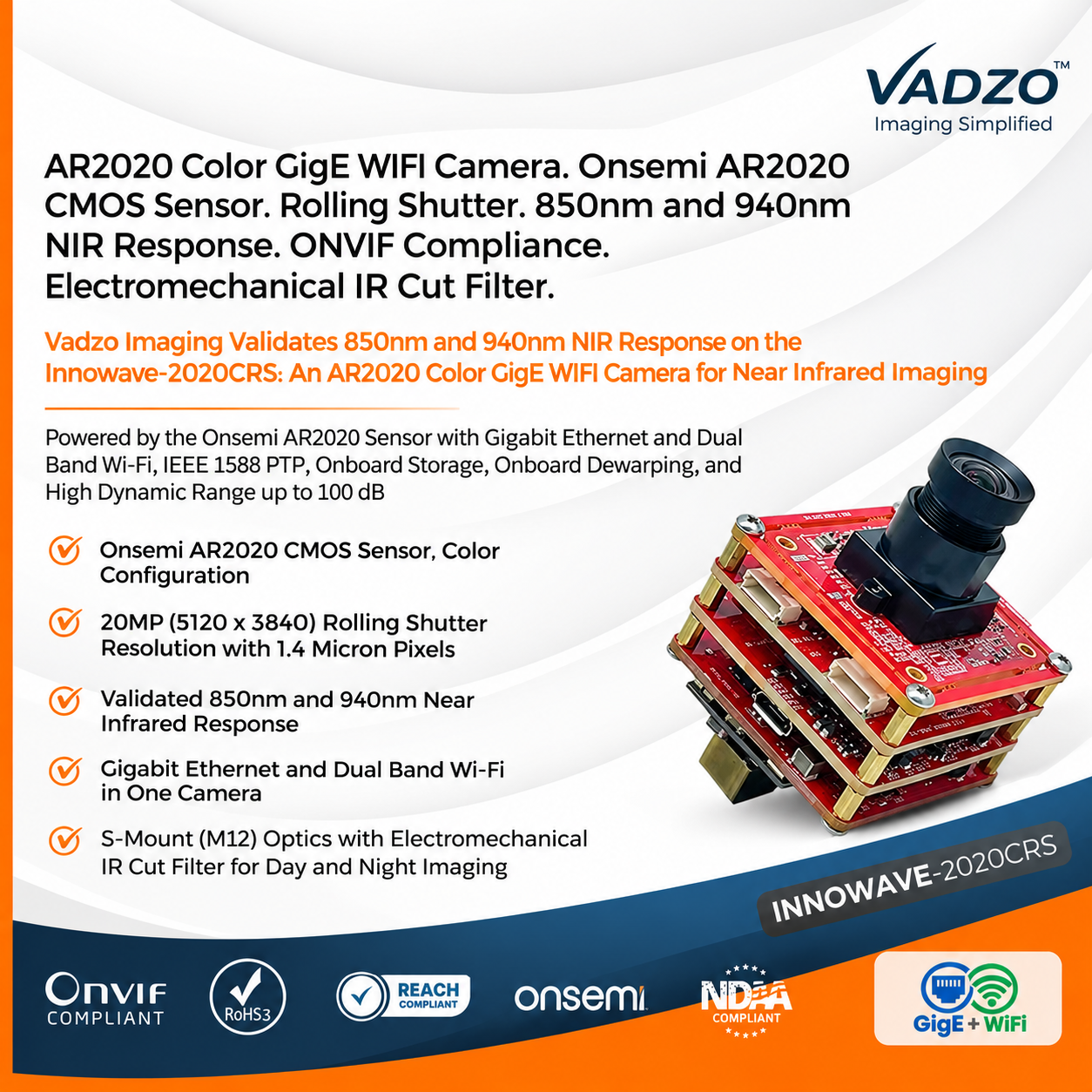

The Innowave-2020CRS is an Onsemi 20MP AR2020 Color GigE Wi-Fi camera, and Vadzo Imaging has validated its near-infrared response at 850nm and 940nm.
FORT WORTH, TX, UNITED STATES, November 2, 2026 /EINPresswire.com/ — Vadzo Imaging, a provider of embedded vision camera products for OEMs and system integrators, today announces the validation of 850nm and 940nm near-infrared response on the Innowave-2020CRS, an AR2020 Color GigE Wi-Fi Camera built on the Onsemi AR2020 sensor. The camera combines Gigabit Ethernet, dual-band Wi-Fi, ONVIF compliance, IEEE 1588 PTP synchronization, onboard storage, and an M12 lens mount with an electromechanical IR-cut filter.
With this validation, Vadzo presents a 20MP NIR GigE Wi-Fi Camera for surveillance, medical, automation, and retail systems. The evaluation also provides guidance on selecting infrared illumination, matching lenses for night imaging, and managing day-to-night operation.
Why an AR2020 Color GigE Wi-Fi Camera Needs Day and Night IR Control
Color image sensors can respond to near-infrared light, which is invisible to the human eye. This sensitivity enables cameras to capture images using infrared illuminators in low-light environments. However, infrared can also affect daytime color reproduction by washing out colors and shifting white balance.
An electromechanical IR-cut filter addresses this challenge. During daylight, the filter blocks infrared light to maintain natural color reproduction. At night, it moves out of the optical path, allowing the sensor to capture infrared illumination. Since color filters become largely transparent to near-infrared wavelengths, night images from a color sensor are effectively monochrome. System designers should account for this behavior when defining image requirements.
Illumination wavelength also affects performance. An 850nm illuminator generally provides a stronger signal and longer range but produces a faint red glow when viewed directly. A 940nm illuminator is invisible to the human eye but provides a weaker signal at equivalent power. It can also receive less background interference from sunlight at that wavelength. The right choice depends on visibility requirements, illumination distance, and the installation environment.
Lens selection is equally important. Infrared light can focus at a slightly different distance from visible light, potentially affecting sharpness at night. An infrared-corrected M12 lens can help reduce this focus shift. Testing the camera with the intended lens and illuminator is therefore important before deployment.
How the Innowave-2020CRS Supports 850nm and 940nm Near-Infrared Imaging
The Innowave-2020CRS is built on the Onsemi AR2020, a 20MP color rolling shutter sensor with a 5120 × 3840 resolution, 1/1.8-inch optical format, and 1.4µm pixels. Vadzo has validated its near-infrared response at both 850nm and 940nm.
The camera uses an M12 S-Mount lens holder with an electromechanical IR-cut filter. The filter blocks infrared during daytime operation and moves aside for night imaging, allowing the sensor to receive infrared illumination. Its 20MP resolution also provides room for cropping and examining regions of interest.
At near-infrared wavelengths beyond approximately 800nm, the sensor’s red, green, and blue filters become largely transparent. As a result, pixels respond similarly to infrared light, producing a monochrome image rather than normal color output. This makes the IR-cut filter important for switching between daytime color and nighttime infrared imaging.
The two common illumination options offer different benefits. An 850nm source provides a stronger signal and longer range, while a 940nm source supports discreet illumination without a visible red glow. Because 940nm illumination can produce a weaker sensor response, the system may require greater illuminator output or longer exposure. Developers should evaluate both wavelengths using the actual scene and required recognition distance.
The camera also provides Gigabit Ethernet with 100Base-T and 1000Base-T modes, dual-band Wi-Fi supporting 802.11a/b/g/n/ac, ONVIF, IEEE 1588 PTP, onboard storage, unicast and multicast streaming, and an onboard dewarping engine supporting lenses up to 200° DFOV. Its sensor offers dynamic range up to 100dB. These capabilities support networked camera installations requiring synchronized imaging, flexible connectivity, and local recording.
Product Overview
The Innowave-2020CRS is a 20MP color network camera built on the Onsemi AR2020 sensor with Gigabit Ethernet and Wi-Fi in one unit and validated near-infrared response. As a 20MP Near Infrared GigE WIFI Camera, it serves illuminated imaging at 850nm and 940nm, and as a 20MP NIR ONVIF GigE WIFI Camera, it works with standard video management software. The 20MP Near Infrared PTP GigE WIFI Camera designation covers IEEE 1588 synchronization across several camera units, and the 20MP NIR Unicast Multicast GigE WIFI Camera designation covers both streaming modes. The camera also serves as an AR2020 Near Infrared Ethernet WiFi Camera, a 20MP Near Infrared Ethernet WiFi Camera, an AR2020 Color NIR GigE WIFI Camera, a 20MP 850nm NIR GigE WIFI Camera, and a 20MP 940nm NIR Ethernet WiFi Camera for designs that need both links.
Key specs: 20MP (5120 x 3840) Max Resolution | Onsemi AR2020 1/1.8 inch Sensor Format | 1.4 micron Pixel | Color with Rolling Shutter | Gigabit Ethernet (100Base-T and 1000Base-T) and Dual Band Wi-Fi (802.11a/b/g/n/ac) | S-Mount (M12) Optics with Electromechanical IR Cut Filter
Key Capabilities of the AR2020 Color GigE Wi-Fi Camera
Validated 850nm and 940nm Near-Infrared Response
Vadzo has validated the sensor’s near-infrared response at 850nm and 940nm. The 850nm band provides a stronger signal and longer illumination range, while 940nm supports invisible illumination with a weaker signal. Developers can select the wavelength based on visibility requirements, working distance, and environmental conditions. Testing with the intended illuminator helps establish the practical image quality and recognition range.
Gigabit Ethernet and Dual-Band Wi-Fi Connectivity
The camera combines 100Base-T and 1000Base-T Ethernet with dual-band Wi-Fi supporting 802.11a/b/g/n/ac. This gives integrators wired and wireless connectivity options within one camera platform. Ethernet is suitable for reliable, high-bandwidth video transmission, while Wi-Fi can simplify commissioning and installations where cabling is difficult.
ONVIF Compliance for Network Video Integration
ONVIF compliance supports integration with compatible network video management and recording systems. This helps system integrators connect the camera with standard video infrastructure and simplifies deployment across multiple locations. Required ONVIF features should be confirmed against the product documentation.
IEEE 1588 PTP for Multi-Camera Synchronization
IEEE 1588 Precision Time Protocol synchronizes camera clocks to a common network time source. This is useful when multiple cameras monitor the same environment and recordings must align accurately. Wired network connections are generally preferable when consistent synchronization is important. Integrators should validate timing performance on their intended network.
Onboard Storage During Network Interruptions
Onboard storage allows the camera to retain footage locally when a network connection becomes unavailable. This helps protect important recordings during temporary Ethernet or Wi-Fi interruptions. System designers should confirm storage capacity, recording duration, and footage retrieval requirements for the intended deployment.
Unicast and Multicast Streaming
Unicast delivers a separate stream to each connected viewer, while multicast allows a single stream to serve multiple viewers through a compatible network. Multicast can reduce network bandwidth usage when several clients need the same video feed. Switch and access-point support should be checked before selecting a streaming configuration.
Onboard Dewarping for Ultra-Wide Lenses
The onboard dewarping engine supports lenses up to 200° DFOV and corrects the distortion associated with ultra-wide viewing angles. This helps produce a more usable image for monitoring applications. Lens selection and dewarping profiles should be evaluated together, particularly when near-infrared illumination is used.
M12 Optics with an Electromechanical IR-Cut Filter
The M12 S-Mount supports a range of lens options for different fields of view. The electromechanical IR-cut filter blocks infrared during the day and moves aside at night to enable infrared imaging. Using an infrared-corrected lens can help maintain focus across visible and near-infrared operation. Vadzo supports lens selection and integration for volume programs.
Up to 100dB Dynamic Range
The AR2020 sensor offers dynamic range up to 100dB, helping retain details in scenes with bright and dark regions. This is useful for monitoring entrances, windows, and other environments with uneven illumination. Actual image performance depends on the lens, lighting, and selected sensor configuration, so testing under real conditions is recommended.
Statement from Vadzo Imaging
“Night imaging involves more than simply adding an infrared illuminator. The camera must block infrared during the day and admit it at night, the color sensor produces monochrome images under infrared illumination, and lens focus can change between visible and infrared wavelengths. The Innowave-2020CRS has been validated at both 850nm and 940nm with these requirements in mind.
“The electromechanical IR-cut filter supports day and night operation, while the 20MP sensor and dual connectivity options provide flexibility for different network installations. We encourage customers to evaluate both illumination bands with their intended lens and operating environment before finalizing a design. Our team supports customers in selecting and validating the right configuration.”
— Alwin Vincent, Product Manager, Vadzo Imaging
Near-Infrared Imaging Applications
Day and Night Surveillance
Surveillance systems need usable images in changing lighting conditions. The Innowave-2020CRS supports daytime color imaging and nighttime infrared capture using an appropriate illuminator. Onboard storage helps retain footage during network interruptions, while 850nm and 940nm illumination options support different visibility and range requirements.
Medical and Laboratory Imaging
Medical and laboratory equipment can use near-infrared illumination for imaging applications that require controlled lighting. The camera’s 20MP resolution and network connectivity support integration into suitable imaging systems. Device manufacturers should independently evaluate illumination safety, image performance, and applicable regulatory requirements for the finished equipment.
Industrial Inspection and Robotics
Industrial inspection systems can use controlled infrared illumination to capture images in environments where visible lighting varies. The camera’s resolution supports detailed image capture, while Ethernet and Wi-Fi provide connectivity options for fixed equipment and mobile platforms. Applications involving fast-moving objects should also assess whether a rolling shutter meets their imaging requirements.
After-Hours Retail Monitoring
Retail stores can use infrared imaging to monitor entrances, stockrooms, and aisles after closing hours. The camera supports day and night operation, while dewarping can provide corrected views when compatible ultra-wide lenses are used. Wired and wireless connectivity options also help accommodate different installation layouts.
Frequently Asked Questions
Q: Why does a color camera need an IR-cut filter if it can detect near-infrared light?
A: A color sensor can respond to infrared light, but unwanted infrared during daylight can affect color reproduction. The IR-cut filter blocks infrared during the day and moves aside at night, allowing the sensor to use infrared illumination. This supports daytime color imaging and nighttime monochrome imaging.
Q: Should a system use 850nm or 940nm illumination?
A: The choice depends on the application. An 850nm illuminator generally provides a stronger signal and longer range but produces a faint red glow. A 940nm illuminator is invisible to the human eye but typically provides a weaker signal at equivalent power. Testing both wavelengths with the intended lens and installation distance helps determine the suitable option.
Q: Why do near-infrared images from a color sensor look monochrome?
A: At near-infrared wavelengths, the sensor’s color filters become largely transparent, causing pixels to respond similarly to infrared light. As a result, normal color separation is lost and the image appears monochrome. The IR-cut filter helps preserve color during daytime operation.
Q: What does 100dB of dynamic range mean?
A: Dynamic range describes the difference between the brightest and darkest signals a sensor can capture. A 100dB range corresponds to a brightness ratio of approximately 100,000:1. This helps retain details in scenes with significant lighting differences, although actual results depend on the camera configuration and environment.
Q: Why choose Vadzo Imaging for near-infrared camera integration?
A: Vadzo Imaging offers embedded camera solutions with validated 850nm and 940nm response, an electromechanical IR-cut filter, Gigabit Ethernet, dual-band Wi-Fi, ONVIF, PTP, and onboard storage. The company also provides engineering support for lens selection, firmware customization, and enclosure integration, helping OEMs and system integrators evaluate camera solutions before volume deployment.
Availability
The Innowave-2020CRS AR2020 Color GigE WIFI Camera built on the Onsemi AR2020 sensor is available now for evaluation and production orders. Evaluation kits include the camera, an M12 lens, and platform documentation, with no minimum order requirement. Teams can test both illuminator bands on their own scene at night, check the day and night changeover with their own lens, and confirm both network links before committing to a production bill of materials, which tells them more than a datasheet comparison alone. Teams that need an infrared-corrected lens or a different dewarping profile can ask Vadzo to review the configuration. Browse the full range of network camera options at Vadzo’s website or discuss OEM integration requirements.
About Vadzo Imaging
Vadzo Imaging is a global provider of embedded vision solutions and delivers high-performance camera technologies and imaging platforms for applications in robotics, industrial automation, UAVs, edge AI, and medical systems. Its products are designed for seamless integration with leading embedded platforms. Vadzo supports customers through hardware customization, firmware development, and module-level drivers, enabling faster development and deployment of vision-based systems across GigE, USB, MIPI, Wi-Fi, and SerDes camera interfaces.
Alwin Vincent
Vadzo Imaging
+1 817-678-2139
alwin@vadzoimaging.com
Visit us on social media:
LinkedIn
YouTube
X
Legal Disclaimer:
EIN Presswire provides this news content “as is” without warranty of any kind. We do not accept any responsibility or liability
for the accuracy, content, images, videos, licenses, completeness, legality, or reliability of the information contained in this
article. If you have any complaints or copyright issues related to this article, kindly contact the author above.

Media gallery