
Residential Air to Water Heat Pump Market to Reach USD 22.18 Billion by 2035 at 5.89% CAGR
The Residential Air to Water Heat Pump Market reached an estimated USD 13.24 billion in 2025 and is projected to grow

Press Release Disclaimer: This is a press release distributed through the XPR Media network. It has not been independently verified by our newsroom.
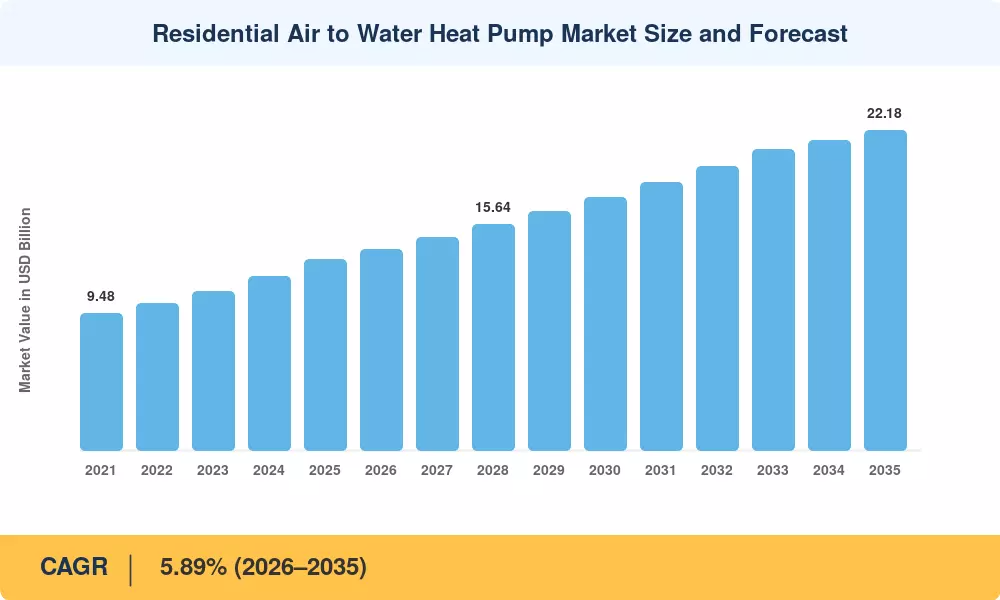

The Residential Air to Water Heat Pump Market reached an estimated USD 13.24 billion in 2025 and is projected to grow from USD 13.93 billion in 2026
NEW YORK, NY, UNITED STATES, July 29, 2026 /EINPresswire.com/ — The Residential Air to Water Heat Pump Market reached an estimated USD 13.24 billion in 2025 and is projected to grow from USD 13.93 billion in 2026 to USD 22.18 billion by 2035, registering a CAGR of 5.89% during the forecast period.
Market Overview
Residential air-to-water heat pumps are highly efficient heating and cooling systems that extract thermal energy from the outside air and transfer it to water, which is then circulated through a home’s heating system, such as radiators or underfloor heating. These systems operate on the principle of vapor-compression refrigeration, using a refrigerant cycle to absorb heat from the ambient air—even at low temperatures—and release it at a higher temperature inside the home. The market encompasses various system types including split systems, monobloc units, all-in-one integrated models, and hybrid combinations, serving both single-family homes and multi-family residences. These systems offer significant energy savings and carbon emission reductions compared to traditional fossil-fuel heating, making them a central technology in the global transition toward sustainable residential heating.
Aggressive decarbonization mandates—most visibly the EU’s revised Energy Performance of Buildings Directive and the U.S. Inflation Reduction Act’s 30% federal tax credits for qualifying heat pump installations—are converting policy ambition into real capital deployment. Homeowners increasingly recognize that the total cost of ownership for a monobloc air-to-water heat pump now undercuts a natural-gas boiler within seven to nine years in most temperate climates, a crossover timeline that subsidies compress further.
A technology shift is well underway in the Residential Air to Water Heat Pump Market as legacy oil and gas boilers give way to inverter-driven, low temperature heat pump underfloor heating configurations. The IEA’s 2024 Global Heat Pump Tracker estimated that global residential heat pump investment surpassed USD 75 billion, with R290 refrigerant heat pump residential models gaining rapid shelf space as manufacturers prepare for the EU F-Gas Regulation phase-down schedule through 2030. Hybrid boiler heat pump combo units bridge the confidence gap for homeowners in colder regions, combining a condensing gas backup with a primary hydronic heat pump radiator system.
Industry trends indicate a decisive shift toward natural refrigerants, smart grid integration, and heat-as-a-service business models. The EU F-Gas Regulation’s accelerated phase-down schedule for high-GWP refrigerants is reshaping product portfolios, with R290 (propane) emerging as the leading replacement with a GWP of just 3. Connected heat pumps that participate in grid balancing programs generate demand-response payments for homeowners, while subscription-based models are removing the upfront cost barrier. AI-enabled optimization and predictive maintenance platforms are projected to reduce service costs by 25–30% and extend compressor lifespans beyond 15 years.
Technological developments are rapidly expanding the market’s capabilities and efficiency. Machine learning algorithms embedded in smart thermostats and heat pump controllers are optimizing seasonal COP by learning occupancy patterns and weather forecasts. Inverter-driven compressor technology is extending reliable operation to –28°C, expanding the addressable market in cold climates. Manufacturers are investing heavily in R290 technology, with production capacity for propane-based units across Europe projected to triple by 2027. Daikin, Viessmann, and Vaillant have each launched residential R290 refrigerant heat pump residential product lines since 2023.
📍 Get Free Sample Report for Detailed Market Insights:
https://www.marketresearchfuture.com/sample_request/31452
Market Segmentation
By Type
The market is segmented by type into Split Systems, Monobloc Systems, All-In-One Integrated, and Hybrid Combinations. Split systems held the dominant position with approximately 44% revenue share in 2025, led by established deployment in Japan and Northern Europe where established distribution networks and certified installer ecosystems favor the format. Monobloc air-to-water heat pump units are gaining traction in retrofit applications thanks to simplified outdoor-only installation requirements, as the entire refrigerant circuit sits outdoors, eliminating the need for F-Gas-certified technicians to handle refrigerant lines inside the dwelling. Hybrid boiler heat pump combo configurations are projected to grow at a 9.50% CAGR through 2035, as they offer fallback heating capacity that reassures homeowners during extreme cold spells while delivering 35–45% carbon savings versus a standalone gas boiler.
By Capacity
Capacity segmentation covers Less Than 10 kW, 10–20 kW, and Greater Than 20 kW. Units below 10 kW captured over 58% of the market share in 2025, reflecting the predominance of single-family dwelling installations where low temperature heat pump underfloor heating systems in well-insulated new builds operate comfortably at 5–7 kW. The 10–20 kW segment accounts for USD 4.17 billion, serving larger homes and partial commercial crossover. Greater than 20 kW units represent the fastest-growing segment at 8.75% CAGR as multi-family residential developers install centralized cascade systems serving 10–30 dwelling units from a single outdoor plant room.
By Application
Application segmentation includes Single-Family Homes and Multi-Family Residences. Single-family homes account for 72.3% share, as owner-occupied dwellings provide direct subsidy access and immediate energy bill benefits. Multi-family residences represent the fastest-growing application segment at a 7.85% CAGR, driven by EU grant programs that subsidize building-wide hydronic heat pump radiator system retrofits and building-level mandates requiring landlords to upgrade shared heating infrastructure.
By Refrigerant
Refrigerant segmentation covers R410A, R32, and R290 (Propane). R410A retains 41.5% share due to legacy installed base and broad component availability. R32 accounts for USD 3.82 billion, serving as a lower GWP transitional option widely adopted in Asia-Pacific. R290 (Propane) is the fastest-growing segment at 9.15% CAGR, driven by EU F-Gas compliance and superior low-temperature COP.
By Installation Type
Installation type segmentation includes New Construction and Retrofit/Replacement. New construction accounts for 38.6% share, driven by building code mandates in EU and select U.S. states. Retrofit/replacement is the fastest-growing segment at 6.42% CAGR, driven by aging boiler stock and renovation subsidy programs across Europe.
By Region
Regional segmentation includes North America, Europe, Asia Pacific, South America, and the Middle East and Africa. North America leads with 36.1% revenue share in 2025. Europe accounts for approximately USD 4.51 billion. The Middle East & Africa region is forecast to achieve the highest CAGR at 8.42% through 2035.
🛒 You can buy this market report at:
https://www.marketresearchfuture.com/checkout?currency=one_user-USD&report_id=31452
Regional Analysis
North America
North America commands the largest regional share at roughly 36% of global revenue, buoyed by federal and state-level incentives across the U.S. and Canada. The United States accounts for 72.4% of regional revenue, with IRA-funded 30% tax credits and state-level electrification codes driving installations in the Northeast and Pacific Northwest. Canada grows at a 6.18% CAGR, with the Greener Homes Grant program disbursing over CAD 2.6 billion since launch, and monobloc air-to-water heat pump units rated for operation below –25°C gaining significant share in provinces like Quebec and Ontario. Mexico contributes USD 0.31 billion in 2025, with new residential construction growth in northern states supporting hybrid boiler heat pump combo installations in affluent residential developments.
Europe
Europe accounts for approximately USD 4.51 billion in 2025 revenue, supported by the REPowerEU plan’s target of deploying 60 million heat pumps by 2030. Germany leads regional demand at 26.8% of European share, with the GEG 65% renewable heating mandate functionally eliminating standalone gas boilers. The United Kingdom grows at a 5.92% CAGR, supported by the Future Homes Standard and Boiler Upgrade Scheme offering GBP 7,500 grants. France contributes USD 0.72 billion, with MaPrimeRénov’ renovation subsidies prioritizing low-temperature heat pump underfloor heating in buildings rated F or G. Italy accounts for 14.2% of regional share, with the Superbonus program (reduced to 70%) still incentivizing R290 refrigerant heat pump residential installations in multi-family apartment blocks. Spain grows at a 6.48% CAGR, driven by the building rehabilitation plan and Mediterranean cooling demand.
Asia-Pacific
Asia-Pacific follows with the second-largest share, driven by China’s aggressive electrification push and Japan’s longstanding adoption of split-system heat pumps. China accounts for 38.5% of regional revenue, with domestic manufacturing cost advantage and urbanization driving demand. India is the fastest-growing major market at an 8.15% CAGR, with green building codes in Tier-1 city residential projects favoring electrified heating and cooling. Japan contributes USD 0.82 billion, with the replacement cycle and EcoCute program legacy sustaining demand. South Korea accounts for 14.7% of regional share, with Korean New Deal green renovation subsidies.
South America
South America represents a smaller but growing market, with Brazil accounting for 62.3% of regional revenue at USD 0.78 billion in 2025. Brazil’s southern states like Rio Grande do Sul and Paraná experience winter temperatures where low temperature heat pump underfloor heating delivers tangible comfort improvements, with Minha Casa, Minha Vida social housing pilots incorporating heat pumps. Argentina grows at a 5.15% CAGR as natural gas subsidy reform gradually improves the economics for heat pump adoption. Chile and Colombia benefit from green building incentives.
Middle East & Africa
The Middle East & Africa region is the fastest-growing at an estimated 8.42% CAGR to 2035, as Gulf states pivot toward energy-efficient cooling-dominant systems in new residential developments. Saudi Arabia accounts for 31.4% of regional revenue, with NEOM and Vision 2030 smart city mandates specifying reversible heat pump systems for an estimated 450,000 residential units. The UAE grows at an 8.85% CAGR, driven by the Dubai Green Building Code and Expo City legacy projects. South Africa contributes USD 0.09 billion, with Eskom load-shedding driving off-grid heating interest. Egypt grows at a 6.74% CAGR, with the New Administrative Capital including R290 refrigerant heat pump residential specifications in government housing tenders.
Competitive Landscape / Key Players
The Residential Air to Water Heat Pump Market exhibits moderate concentration, with the top five players collectively accounting for an estimated 51–53% of global shipments in 2024. Key companies operating in this market include Daikin Industries (~14–17% share), Carrier / Viessmann (~12–15%), Mitsubishi Electric (~9–12%), Bosch Thermotechnology (~7–10%), Trane Technologies (~5–8%), Vaillant Group (~4–7%), Samsung HVAC (~3–6%), Panasonic (~3–5%), NIBE Industrier (~3–5%), and LG Electronics (~2–4%).
Strategic developments in the market include significant capacity expansions and product launches. In March 2025, Daikin Industries opened a EUR 300 million heat pump manufacturing plant in Łódź, Poland, with annual capacity of 500,000 monobloc air-to-water heat pump units, targeting the European retrofit market. In January 2024, Carrier completed integration of Viessmann Climate Solutions following its EUR 12 billion acquisition, consolidating R&D operations and launching a unified product portfolio across 30 European countries. In November 2024, Vaillant Group achieved its 500,000th R290 refrigerant heat pump residential unit shipment, making it the first manufacturer to reach this milestone for propane-based systems in Europe.
Competitive differentiation increasingly hinges on R290 refrigerant expertise, cold-climate performance, and smart home integration. Manufacturers investing in R290 technology benefit from consumer preference advantages and regulatory fast-tracking, while those establishing scale manufacturing capture 8–12% price premiums. Daikin and Mitsubishi Electric offer 10-year coverage on inverter compressors when installed by certified partners, leveraging warranty terms as a competitive advantage.
Latest Industry News & Developments
Recent industry developments highlight the ongoing transformation of the residential air-to-water heat pump market toward R290 refrigerants, smart integration, and scalable manufacturing. In March 2025, Daikin Industries opened a EUR 300 million heat pump manufacturing plant in Łódź, Poland, with annual capacity of 500,000 monobloc air-to-water heat pump units, targeting the European retrofit market. This investment reflects the surging demand for heat pumps in Europe driven by decarbonization mandates.
In January 2024, Carrier completed integration of Viessmann Climate Solutions following its EUR 12 billion acquisition, consolidating R&D operations and launching a unified product portfolio across 30 European countries. The acquisition reshaped the competitive hierarchy, consolidating European and North American distribution under a single entity.
In November 2024, Vaillant Group achieved its 500,000th R290 refrigerant heat pump residential unit shipment, making it the first manufacturer to reach this milestone for propane-based systems in Europe. This milestone demonstrates the accelerating transition toward natural refrigerants in the market.
Market Challenges & Opportunities
Key restraints facing the residential air-to-water heat pump market include installer shortages and certification bottlenecks, with the European Heat Pump Association estimating a deficit of 50,000 certified installers across the EU in 2024. High upfront costs versus gas boiler replacement, with typical installations costing EUR 10,000–16,000 compared to EUR 3,000–5,000 for a replacement gas boiler, remain a decisive barrier. Grid capacity constraints in dense suburbs, with peak winter demand adding 3–5 kW per household, create transformer upgrade backlogs of 18–24 months. Municipal noise ordinances on outdoor units and consumer skepticism in extreme-cold climates further constrain growth.
Future potential lies in heat-as-a-service business models, with subscription-based heat pump models removing the upfront cost barrier and opening the market to price-sensitive segments. Smart home integration and demand-response revenue offer homeowners USD 50–120 per year in grid balancing payments. AI-enabled optimization and predictive maintenance are projected to reduce service costs by 25–30% and extend compressor lifespans beyond 15 years. The electrification supercycle and sector coupling will create opportunities where rooftop solar, battery storage, and hydronic systems share a common energy management platform. ESG reporting and green mortgage integration will create self-reinforcing demand loops, with green mortgage products offering rate reductions for homes equipped with heat pumps.
To explore more market insights, visit us at:
https://www.marketresearchfuture.com/reports/residential-air-to-water-heat-pump-market-31452
Final Market Summary
The residential air-to-water heat pump market is positioned for sustained growth through 2035, driven by decarbonization mandates, fiscal incentives, the natural refrigerant transition, and falling hardware costs. The projected valuation of USD 22.18 billion reflects rapidly expanding adoption across single-family and multi-family residences, with the market transitioning from legacy fossil-fuel heating toward highly efficient, electric, and increasingly smart and connected systems.
The medium-term growth outlook remains positive, with the market registering a CAGR of 5.89% during the forecast period. North America will continue to maintain market leadership through IRA incentives and electrification codes, while Europe remains a growth engine through aggressive policy frameworks. The ongoing development of R290 refrigerant technology, AI-enabled optimization, and heat-as-a-service business models will continue to expand market possibilities and applications.
Long-term industry potential extends beyond the current forecast horizon. The electrification supercycle, with the IEA projecting heat pumps will supply 55% of global residential heating demand by 2035, will create sector-coupling opportunities where homes become prosumer nodes within the broader grid. Platform economics and heat-as-a-service scale will expand beyond pilot programs to become mainstream distribution channels, with utilities bundling electricity supply with heat pump hardware to accelerate penetration among middle-income households. ESG reporting and green mortgage integration will create self-reinforcing demand loops as Scope 3 emissions reporting becomes mandatory and institutional capital flows into low-carbon heating. Manufacturers that successfully develop R290 expertise, invest in smart home integration, and adapt to emerging business models will capture substantial value in this evolving market. The transformation of residential heating from fossil fuel dependence to efficient, electric, and intelligent heat pump systems represents a fundamental advancement in building decarbonization and home energy management, enabling a sustainable and comfortable future for homeowners worldwide.
More Related Reports from MRFR Library:
Industrial Wireless Automation Market: https://www.marketresearchfuture.com/reports/industrial-wireless-automation-market-31436
Material Handling Integration Market: https://www.marketresearchfuture.com/reports/material-handling-integration-market-31439
Plasma Cutting Machine Market: https://www.marketresearchfuture.com/reports/plasma-cutting-machine-market-31442
Screw Pumps Market: https://www.marketresearchfuture.com/reports/screw-pumps-market-31455
Separation Machinery Market: https://www.marketresearchfuture.com/reports/separation-machinery-market-31457
Gun Safe Market: https://www.marketresearchfuture.com/reports/gun-safe-market-31643
Industrial Electric Boiler Market: https://www.marketresearchfuture.com/reports/industrial-electric-boiler-market-32212
Smart Vending Machine Market: https://www.marketresearchfuture.com/reports/smart-vending-machine-market-32574
Industrial Refrigeration System Market: https://www.marketresearchfuture.com/reports/industrial-refrigeration-system-market-33963
Disposable Gown Market: https://www.marketresearchfuture.com/reports/disposable-gown-market-34058
Larry Wilson
WantStats Research And Media Pvt. Ltd.
+1 855-661-4441
email us here
Legal Disclaimer:
EIN Presswire provides this news content “as is” without warranty of any kind. We do not accept any responsibility or liability
for the accuracy, content, images, videos, licenses, completeness, legality, or reliability of the information contained in this
article. If you have any complaints or copyright issues related to this article, kindly contact the author above.

Media gallery

