Mr. Dent Collision Repair Explains How Collision Damage Can Affect Hood Latches and Release Systems
Ozark, MO - October 14, 2026 - PRESSADVANTAGE - Mr. Dent Collision Repair has published consumer guidance explaining

Press Release Disclaimer: This is a press release distributed through the XPR Media network. It has not been independently verified by our newsroom.

Ozark, MO – October 14, 2026 – PRESSADVANTAGE –
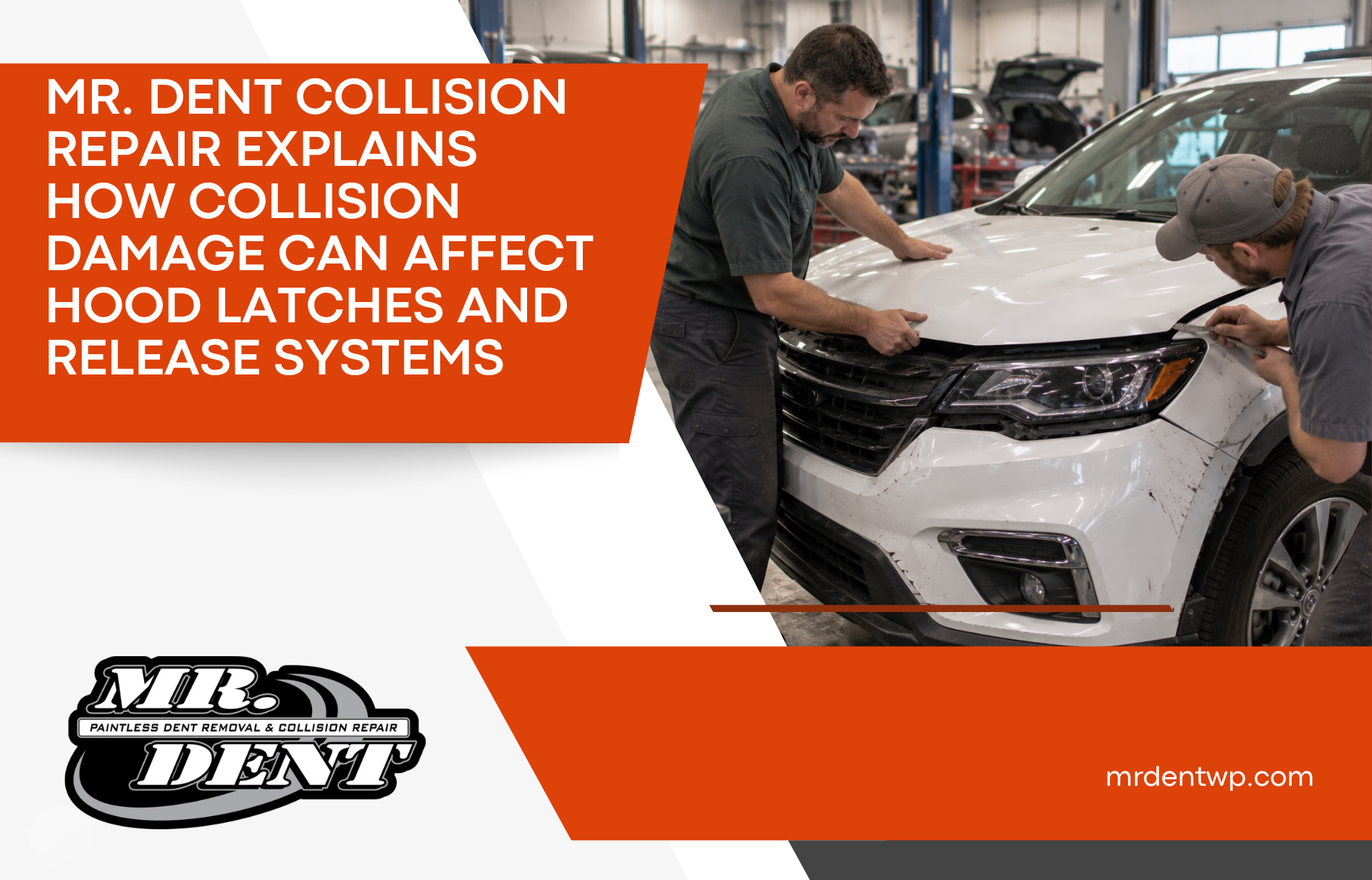
Mr. Dent Collision Repair has published consumer guidance explaining how front-end collision damage can affect hood latches and release systems even when the hood itself remains attached and appears capable of opening or closing. The October publication focuses on three connected areas that can influence hood operation after an accident: the hood and its position, the latch and release components, and the surrounding body areas that support the complete assembly.
The guidance expands on Mr. Dent Collision Repair’s collision repair services by addressing an area that can be overlooked when attention is initially drawn to a damaged bumper, grille, fender, or hood surface. Hood operation depends on several components working together, and changes elsewhere in the front body can affect that relationship.
The hood’s position forms the first area addressed in the October guidance. A hood is supported by hinges and designed to meet the surrounding body panels and latch area in a specific position. Collision forces can change that position even when the hood does not show extensive visible deformation.
A front-end or angled impact can affect the hood itself, adjoining fenders, grille area, front body components, hinges, or mounting locations. When one of these areas moves, the hood may no longer approach the latch in the same way it did before the collision.
Changes can include uneven spacing around the hood, a leading edge that sits higher or lower than adjoining components, additional effort required to close the hood, or movement that feels different from its pre-collision operation.
These observations do not establish which component has been damaged. A hood that becomes difficult to close can involve the hood, hinge position, latch area, surrounding body components, or a combination of conditions. Evaluating the connected parts helps identify the source of the change.
The latch assembly forms the second part of the guidance. Hood latches are designed to secure the hood when it is closed. Their design and location vary by vehicle, but normal operation depends on the relationship between the latch and the corresponding component on the hood.
An impact can change that relationship without visibly breaking the latch. If surrounding mounting areas move or the hood changes position, the components may no longer meet as intended.
The publication emphasizes that simply adjusting a latch to compensate for other collision damage may not address the underlying condition. The hood, latch, mounting locations, hinges, and surrounding collision area can be considered together before the appropriate repair operations are determined.
Many hood assemblies also incorporate a secondary retaining mechanism. Vehicle-specific designs differ, making applicable manufacturer information important when evaluating components involved in securing the hood.
Release components are another part of the system. Depending on the vehicle, opening the hood can involve an interior release handle, cable or other mechanical connection, latch assembly, and an exterior release mechanism beneath the hood.
Collision damage can affect the routing, attachment, position, or operation of these components when they are located within or connected to the damaged area. A release that suddenly feels unusually loose, requires additional effort, or operates differently following an accident can provide useful information during an assessment.
These symptoms do not automatically mean that the release cable or latch needs replacement. The change can originate elsewhere within the connected system, which is why the individual components and their mounting locations are evaluated rather than relying on the symptom alone.
The surrounding front body forms the third part of the October framework. Hood operation is influenced by more than the hood and latch themselves. Fenders, hinges, supports, mounting areas, bump stops, and other vehicle-specific components can contribute to how the hood sits and closes.
Mr. Dent Collision Repair’s auto body repair services provide additional context for evaluating these adjoining areas. Repair planning can include assessing how collision-damaged panels and mounting locations relate to one another before determining the appropriate repair or replacement operations.
This becomes particularly relevant when the most obvious damage is located below the hood. A damaged bumper or grille can draw attention to the lower portion of the front end, while the force of the collision may also warrant evaluation of components positioned farther into the affected area.
The October guidance does not suggest that every front-end collision damages the hood latch or release system. A minor impact may leave these components unaffected. The purpose of the publication is to explain why their operation and position can be considered when the collision occurs in an area connected with the hood assembly.
Manufacturer repair information can also influence repair planning. Hood construction, hinge designs, latch arrangements, mounting methods, adjustment procedures, and component requirements vary among vehicles. Applicable procedures provide vehicle-specific information rather than relying on one approach for every make and model.
The guidance also distinguishes exterior appearance from operation. Repairing a dent or refinishing a damaged hood addresses visible body damage, while confirming how the hood opens, closes, and engages with its related components addresses a different aspect of the affected assembly.
For consumers, changes in hood operation following an accident can therefore provide useful information during the repair evaluation. A hood that does not sit as it did before the collision, requires unusual effort to close, or has a release mechanism that behaves differently can be documented along with the visible damage.
The October publication gives vehicle owners a clearer framework for understanding why a front-end repair may involve more than restoring the appearance of the hood. The hood, hinges, latch, release components, mounting areas, and adjoining body sections function as a connected assembly and can require individual evaluation when located within the collision-damaged area.
Additional information about Mr. Dent Collision Repair and its approach to vehicle repairs is available through the company’s About Us page.
Mr. Dent Collision Repair provides collision repair, auto body repair, paintless dent repair, and related vehicle repair services for drivers in Southwest Missouri. The company has served area vehicle owners for more than three decades, with repair planning focused on the documented condition and applicable procedures for each vehicle.
###
For more information about Mr. Dent Collision Repair, contact the company here:
Mr. Dent Collision Repair
Logan Martin
417-581-5103
logan@mrdentmo.com
2116 N 20th St, Ozark, MO 65721, United States