
Wheeled-Legged Hybrids Are Redefining the Robot Dog Market-Here’s How
BEIJING, CN / ACCESS Newswire / August 21, 2026 / With the rapid evolution of autonomous mobile robotics, legged robots

Press Release Disclaimer: This is a press release distributed through the XPR Media network. It has not been independently verified by our newsroom.

BEIJING, CN / ACCESS Newswire / August 21, 2026 / With the rapid evolution of autonomous mobile robotics, legged robots are accelerating their deployment across industries-from routine patrols in municipal districts and meticulous inspections of underground utility tunnels, to emergency rescue missions and polar expeditions. In current industry applications, this field has branched into two major technological paths: pure quadruped robot dogs and wheeled-legged hybrid robot dogs. Faced with diverse industrial and municipal demands, the question of how to make the right technical choice between these two options-and how to maximize their effectiveness in practice-has become a focal point in the global industrial intelligent transformation landscape.
I. Point-Foot Walking vs. Wheel-Leg Switching: Divergent Underlying Design Logics
The technological divergence between the two stems from different emphases on “traversability” versus “efficiency.”
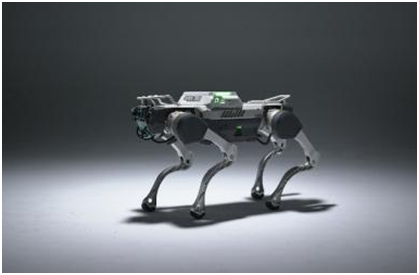
Quadruped robot dogs employ multi-joint biomimetic leg structures, mimicking the locomotion mechanisms of four-legged animals. Their design core lies in tackling extreme unstructured terrains. Through simulated walking, climbing, jumping, and crawling, pure quadruped robots achieve stable traversal in the most hostile environments.
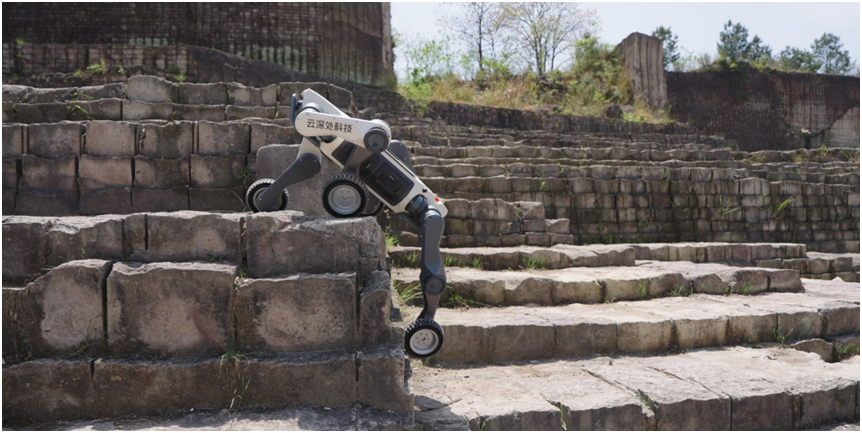
In contrast, wheeled-legged hybrid robot dogs integrate rolling mechanisms into their feet, autonomously switching between sliding and gait modes depending on the terrain. Their design philosophy aims to strike a balance between smooth surfaces and obstacle-filled terrains-ensuring high-speed cruising on flat ground while maintaining obstacle-crossing capabilities on complex surfaces.
II. Wheeled-Leggedvs. Quadruped: Key Differences in Speed, Endurance, Obstacle Crossing, Stability, and Acoustic Signature
The fundamental differences in locomotion mechanisms give rise to distinct motion capabilities and operational characteristics. In real-world industrial and municipal selection processes, the following five dimensions are typically the core metrics for evaluating operational efficiency.
1. Speed – Mobility Efficiency: Which Is Faster? Which Is More Stable?
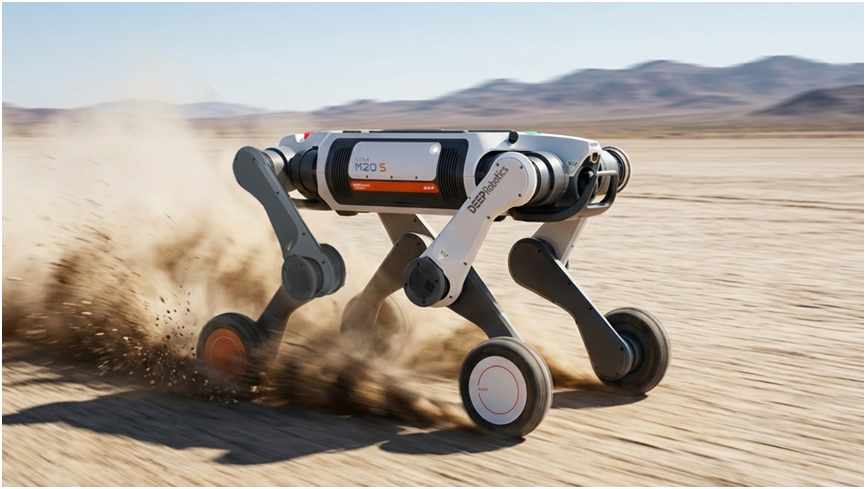
Pure quadruped robots rely on the reciprocating gait of mechanical legs. Constrained by the physical limits of joint oscillation frequency, their movement speed typically ranges from 1.5 to 5 meters per second, with designs prioritizing high-precision operations at lower speeds. Wheeled-legged robots, however, break free from gait constraints through wheeled gliding, experiencing minimal resistance on flat surfaces. For example, DEEP Robotics’ Lynx M20S achieves a top gliding speed of 9 meters per second, significantly reducing time consumption for large-scale factory patrols and routine long-distance inspections.
2. Endurance – Energy Consumption: Which Is More Energy-Efficient?
In terms of endurance, the continuous joint flexion and extension of pure quadruped robots result in relatively stable energy output-performing reliably in rugged, obstacle-strewn terrains and enabling stable operation in complex scenarios. Wheeled-legged robots, however, demonstrate significant energy-saving advantages on flat surfaces. By leveraging wheeled gliding, they optimize energy consumption structures and achieve high energy utilization efficiency, making them better suited for large-scale, long-distance routine inspections.
3. Obstacle Crossing – Which Can Go More Places?
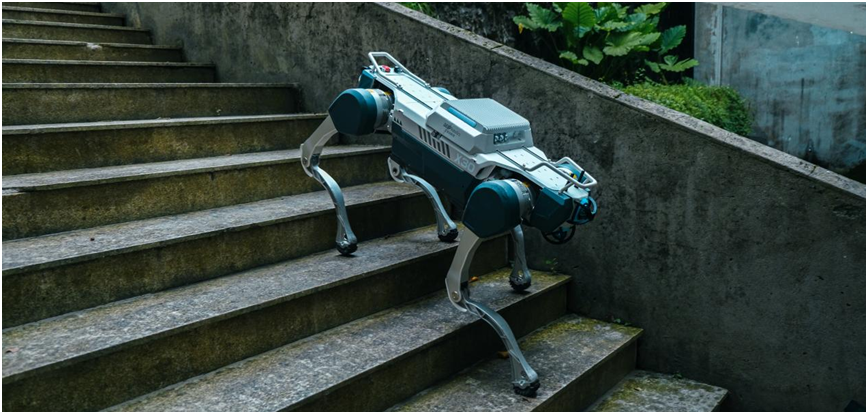
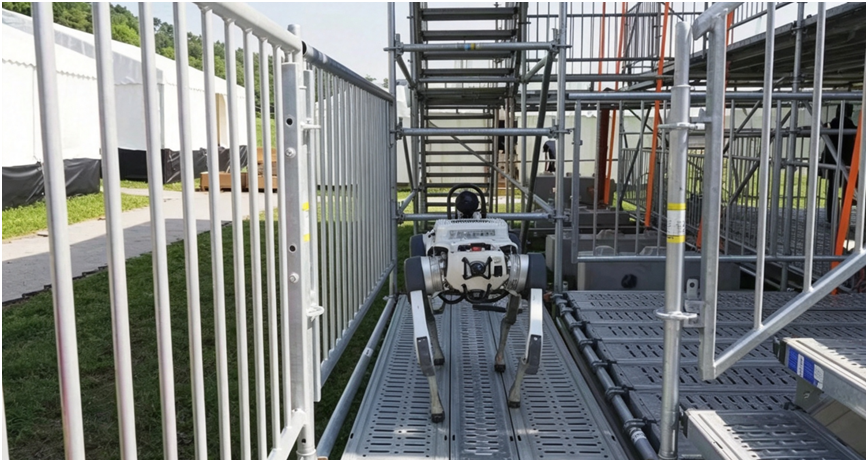
Quadruped robots benefit from highly articulated biomimetic joint designs, allowing flexible adjustment of stride length and posture. They can steadily climb continuous open-grid stairs, traverse rubble, and even navigate debris-making them a reliable choice for irregular terrains. Wheeled-legged robots, through their ability to switch between wheel and leg modes, achieve dual advantages: they use wheels on flat surfaces to reduce energy consumption, and automatically switch to legged gaits when encountering stairs or slopes-maintaining good traversability without sacrificing overall mobility efficiency.
4. Stability – Which Is More Resilient to Disturbances?
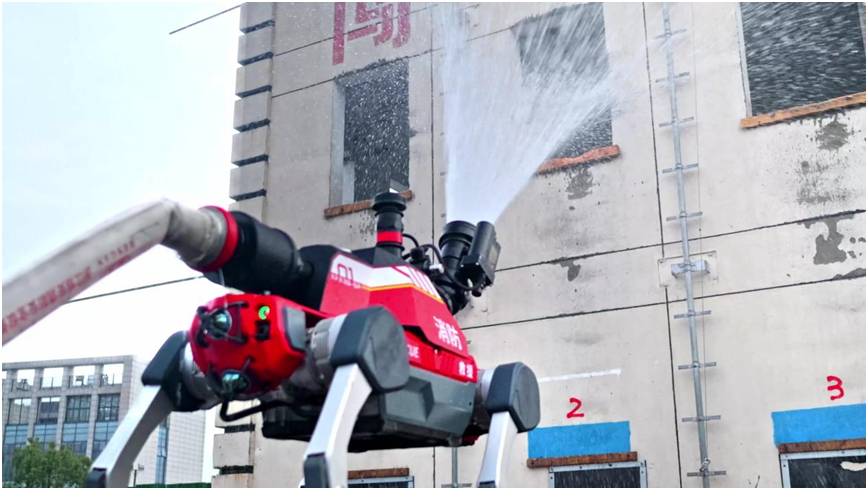
The multi-contact physical structure of quadruped robots provides exceptionally high static and dynamic stability. In the event of sudden strong impacts or extreme posture disturbances, the control system rapidly calculates optimal footholds to balance forces. For instance, in firefighting rescue scenarios, the X30 quadruped robot leverages dynamic gait modulation to maintain a firm stance, effectively counteracting the massive recoil generated by high-pressure fire hoses. Wheeled-legged robots, meanwhile, rely more on active control and compliant response. Using adaptive impedance control algorithms, they can limit body pitch fluctuations to within ±1.2 degrees when traversing speed bumps and other road irregularities.
5. Acoustic Signature – Which Operates More Quietly?
Operational noise directly impacts the suitability of robots for human-robot collaborative environments. Pure quadruped robots, due to intermittent impact sounds from foot contacts and motor operation, may produce audible interference in extremely quiet indoor settings. Wheeled-legged robots, on the other hand, generate low friction noise when gliding on flat surfaces, operating more quietly and integrating seamlessly into office, community, and everyday indoor scenarios.
III. Precise Scenario Matching: Quadrupeds for “Precision,” Wheeled-Legs for “Coverage”
In practical applications, the two types of robots assume distinct roles-“specialist for challenging terrains” versus “efficiency pioneer.” Quadruped robots are better suited for extreme unstructured terrains, capable of penetrating dark, signal-void, smoke-filled hazardous confined spaces to perform high-precision search and inspection tasks. At large European nuclear power plants (such as Leibstadt Nuclear Power Plant in Switzerland), quadruped robots can steadily climb 45-degree slopes and nimbly navigate narrow gaps between equipment, effectively reducing blind spots in manual O&M.
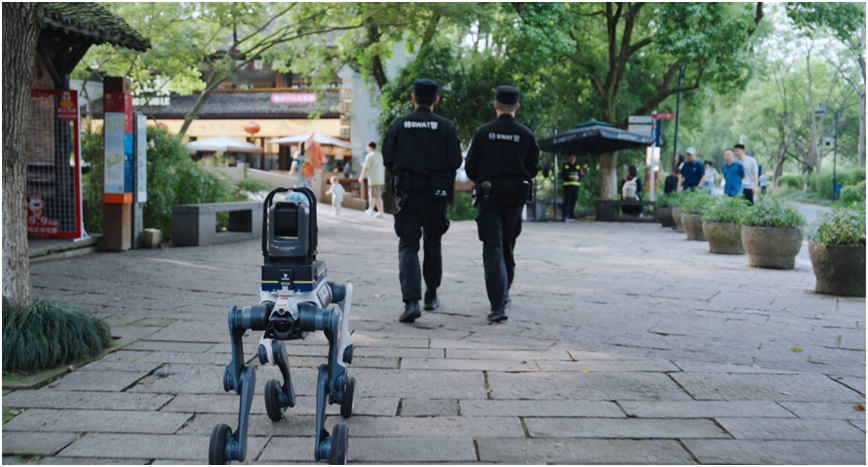
Wheeled-legged robots, by contrast, excel in wide-area patrols across primarily flat terrain with only scattered simple obstacles. In municipal districts and long-distance campus patrols, wheeled-legged robots can conduct 24/7 patrols along preset routes, ensuring public security efficiency while integrating smoothly into daily community life.
IV. Not a Single-Choice Question: Dual-Morphology Collaboration Is the Optimal Solution
Industry experts point out that future intelligent upgrades are not about competition between single morphology robots, but rather about coordinated operations involving dual morphologies and multi-system collaboration. The “wheeled-leg + quadruped” collaborative working model has been validated in multiple industrial deployment projects worldwide.
In joint inspections at large substations, the “rapid scan + precision diagnosis” closed-loop model is becoming mainstream: wheeled-legged robots leverage high-speed gliding for broad “area” rapid surveys and efficient material delivery, reducing inspection cycles to one-third of their original duration; quadruped robots focus on in-depth “point” diagnostics, accessing corners beyond human reach to perform high-precision infrared thermometry and equipment status assessments. In large-scale international sports event security, the two devices similarly form efficient complements-wheeled-legged robots swiftly navigate through crowds to transmit live footage, while quadruped robots stand guard in critical zones, cross-validating anomalies through multi-sensor fusion to build an all-weather, full-domain intelligent protection network.
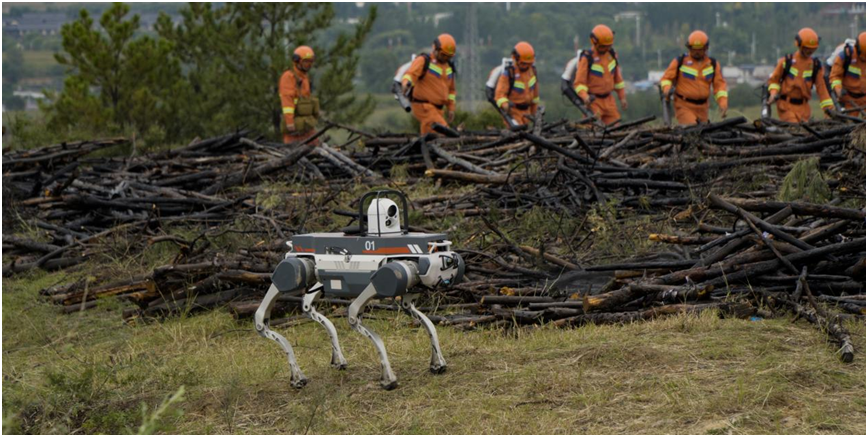
V. Leveraging Respective Strengths to Build Full-Scenario Intelligent Protection
The next phase of competition in intelligent robot dogs has moved beyond the evolution of single morphologies toward competing in full-scenario, systematic solution capabilities. As a representative enterprise in the legged robot domain, DEEP Robotics has now achieved a comprehensive product portfolio covering “quadruped + wheeled-legged + humanoid.” Its flagship quadruped robot X30 and Lynx series (M20/M20S/S10) wheeled-legged robots have been deployed in over 1,200 industry scenarios worldwide, spanning core sectors such as power and energy, emergency firefighting, and security patrols.
From high-altitude wilderness uninhabited zones to urban core substations, understanding the fundamental differences between these two morphologies is not about making an either-or choice-it is about enabling each to excel in its respective strengths and deploying them flexibly based on real-world scenarios, thereby achieving fully integrated, end-to-end systematic solutions.
Company: DEEP Robotics
Contact: Vivian Chen
Email: chenlingjia@deeprobotics.cn
Website: https://www.deeprobotics.cn/en
SOURCE: DEEP Robotics
View the original press release on ACCESS Newswire

